In a world where first impressions often count, fashion has emerged as one of the most immediate and powerful tools of communication. Without speaking a word, your clothing can reveal your mood, interests, culture, values, and even aspirations. In this sense, fashion as self-expression goes far beyond trends or labels—it’s a visual language we all speak, whether we realize it or not.
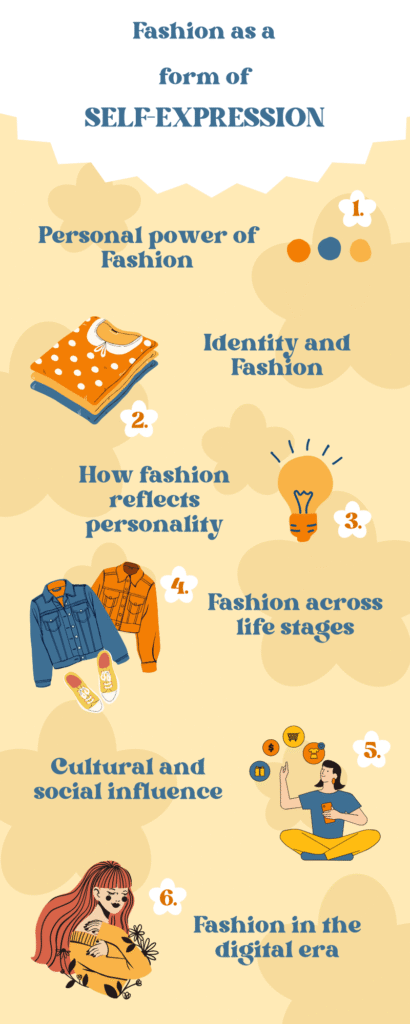
The Personal Power of Fashion
Fashion is deeply personal. Every individual interprets it differently, creating a unique visual narrative through their clothing choices. From subtle wardrobe selections to bold, statement-making outfits, fashion offers a canvas on which people project their inner world. For some, it’s a way to rebel against norms; for others, it’s a quiet celebration of who they are.
This is especially important in a time when individuality is celebrated. People are turning away from cookie-cutter styles and embracing more eclectic and expressive wardrobes. In this shift, fashion as self-expression is no longer a luxury—it’s a right.
Identity and Fashion: More Than Just Style
The relationship between identity and fashion is complex and dynamic. Clothes are not merely fabric stitched together; they are layered with meaning. We often associate certain looks with professions, personalities, or social groups. A black leather jacket might convey rebellion. A crisp suit might reflect professionalism. A colorful sari or kimono can express cultural heritage.
Moreover, fashion can reflect intersectional identities—gender, race, age, and even political stance. The rise of gender-neutral fashion, for instance, reflects a growing cultural dialogue around gender identity and expression. Individuals are choosing pieces that align with who they feel they are internally, not just what society expects of them externally.
Fashion allows people to construct, explore, and even challenge their identities. For example, someone exploring their gender identity may use clothing to experiment with femininity, masculinity, or a blend of both. In doing so, they use fashion not just to reflect but also to discover themselves.
How Fashion Reflects Personality
We often hear the phrase, “You are what you wear,” and in many ways, this rings true. Our clothes speak volumes about our personalities, even before we introduce ourselves. But how fashion reflects personality isn’t always straightforward—it’s subtle, nuanced, and ever-changing.
Take someone who prefers structured, minimalist styles. This might indicate a personality that values order, control, and simplicity. On the other hand, someone who embraces colorful, bold patterns might be more extroverted, playful, and open to experimentation.
Fashion also reflects our emotional state. A bright outfit on a gloomy day can be an act of resistance, while an oversized hoodie might be a sign of retreat and comfort. Unlike words, which can be filtered, our style often reveals our truest feelings.
Psychologists have studied the phenomenon known as “enclothed cognition”—the idea that what we wear influences not only how others perceive us but also how we perceive ourselves. So, choosing clothes that reflect our personalities can actually reinforce our self-concept and confidence.
Fashion Across Life Stages
Our style changes as we grow. Teenagers might use fashion to rebel or fit in, while adults often tailor their style to align with careers or family roles. Seniors may embrace comfort or lean into vintage aesthetics that connect with their past. In all stages, fashion is an evolving form of autobiography.
For children, fashion is often controlled by parents, but as independence grows, so does the desire to express individuality. Adolescents, in particular, begin to use fashion to align with peer groups or stand apart from them. This fluid relationship with style is a reflection of self-discovery and identity formation.
In adulthood, fashion choices may become more strategic—balancing expression with functionality. But the underlying drive remains the same: to express who we are, what we value, and how we want the world to see us.
Cultural and Social Influence
Our fashion is also shaped by where we come from—culturally, socially, and geographically. Traditional garments, for instance, are not only tied to heritage but also to identity. A Nigerian gele, a Scottish kilt, or an Indian lehenga does more than signify culture—it tells a story of belonging and pride.
In the digital age, subcultures have also influenced the way we express ourselves through style. Streetwear, cottagecore, techwear, and minimalism all offer frameworks that help individuals visually associate with like-minded communities. These styles are not just aesthetic—they carry codes, values, and philosophies.
Social movements have also used fashion as a form of protest. The black berets of the Black Panthers, the pink pussyhats of feminist marches, and climate activists’ recycled fashion are all examples of how clothes can communicate resistance, hope, and advocacy.
Fashion in the Digital Era
The rise of social media has further magnified the role of fashion in self-expression. Platforms like Instagram, TikTok, and Pinterest have turned everyday people into curators of personal style. Online spaces offer freedom to experiment with aesthetics and connect with others who share a visual or cultural language.
At the same time, fast fashion and algorithm-driven trends can also make self-expression feel commercialized or performative. To stay authentic, many are moving toward slow fashion, upcycling, and DIY styles—prioritizing originality over mass-produced sameness.
Digital fashion is also on the rise. With virtual avatars and fashion NFTs, self-expression is evolving into new realms where individuals can explore identities in imaginative, limitless ways.
Finding Your Fashion Voice
If you’re wondering how to use fashion as self-expression, the journey begins with self-awareness. Ask yourself:
- What colors make you feel like yourself?
- What silhouettes do you gravitate toward and why?
- Which outfits boost your confidence?
- What message do you want your clothes to send?
You don’t need a stylist or a designer wardrobe to express yourself through fashion. Even the most modest choices—a thrifted jacket, a handmade bracelet, a bold lipstick—can speak volumes.
The key is to wear what resonates with you, not just what’s trending. Authentic style doesn’t come from mimicry—it comes from alignment with your inner self.
Conclusion
Fashion is not just about looking good—it’s about feeling seen, understood, and empowered. It allows you to define yourself on your own terms, using fabric, texture, color, and silhouette as your tools. As society becomes more accepting of individuality and creative freedom, embracing fashion as self-expression is not just an aesthetic choice—it’s a statement of identity, agency, and self-love.
So, whether you dress to blend in or to stand out, remember that every outfit is an opportunity—to connect, to communicate, and most importantly, to be you.